
Marble racing turns a simple rolling marble into the centre of an exciting competition. Several marbles travel along a course filled with slopes, curves, tunnels, ramps and other obstacles. The aim is usually to reach the finish line before the other competitors. The Marble Race Game can be enjoyed as a physical track activity, a digital simulation, a casual online race or a live audience event. The exact controls and rules depend on the version, so learning the format before starting is important.
This guide explains the common formats, how a race works, basic rules, track features and beginner-friendly tips for anyone exploring the Marble Race Game. It also explains why previous results cannot guarantee the outcome of a future race.
What Is a Marble Race Game?
A Marble Race Game is a racing activity in which marbles compete on a purpose-built or digitally simulated track. In a physical setup, real glass or plastic marbles roll down a track under gravity. In a digital version, a game engine simulates movement, collisions, speed and track conditions on a screen.
The central idea of the Marble Race Game is easy to understand: marbles start from a designated point, follow the course and are ranked according to where they finish. Some games are designed mainly for watching, while others let participants choose a marble, steer it, use abilities or join a multiplayer race.
There is no single universal rulebook. A simple toy track may only require a fair release from the same starting gate. An arcade title may include keyboard or touch controls. A live-stream format may let viewers join a race through audience interactions. A casino-style product can have separate betting rules and should not be confused with a casual racing simulator.
How to Play Marble Race Game
The steps below describe a typical Marble Race Game. The options available to you may differ depending on whether you are using a physical track, a browser game, a mobile app or a live event.
1. Choose the Version You Want to Play
Start by identifying the type of experience. A physical marble run is suitable for hands-on play, while a digital simulator may offer different tracks, camera views and race modes. Read the on-screen instructions before selecting a mode.
2. Select or Assign the Marbles
Some formats let players choose a colour or customise a marble. Others assign each competitor a marble automatically. In a name-picker or group activity, participants may enter names before the race and have them displayed beside the marbles.
3. Review the Track and Controls
Look at the route before the start. Identify steep drops, sharp turns, narrow lanes, moving obstacles and possible shortcuts. If the game includes steering or special abilities, learn the controls during a practice round rather than waiting until the competition begins.
4. Start the Race
In a physical race, release the marbles together from the same starting gate. In a digital version, use the start command or wait for the countdown. Fair starting conditions make the result easier to compare.
5. Follow the Marbles
Watch how each marble moves through the course. The order can change after a collision, a narrow turn or a steep section. Some games show a live leaderboard, while others display only the race itself.
6. Confirm the Finish and Results
The winner is usually the first marble to cross the finish line. A tournament may use several rounds or points instead of one final sprint. Check the result screen and the rules for how ties, disqualifications or unfinished runs are handled.
Basic Rules of Marble Racing
Although different versions use different systems, most simple races share a few basic principles. These rules provide a useful starting point for beginners.
| Rule | What It Means |
|---|---|
| Starting position | Competitors begin from the designated starting area. |
| Race route | Each marble follows the course defined for that round. |
| Track boundaries | A marble that leaves the track may be stopped, reset or eliminated, depending on the rules. |
| Obstacles | Ramps, turns, gates and barriers are part of the course unless the rules say otherwise. |
| Finish line | Finishing order is normally based on which marble crosses the line first. |
| Multiple rounds | In a tournament, rankings or points may carry over between races. |
| Fair start | Marbles should receive the same starting conditions in a fair comparison. |
In a Marble Race Game, the instructions provided by the organiser or platform take priority over these general guidelines. For example, some games allow steering, while others run automatically. Some declare the first finisher the winner; others use elimination rounds or a points table. For platform-related information, you can also visit Mahadev Book Official.
Popular Types of Marble Racing
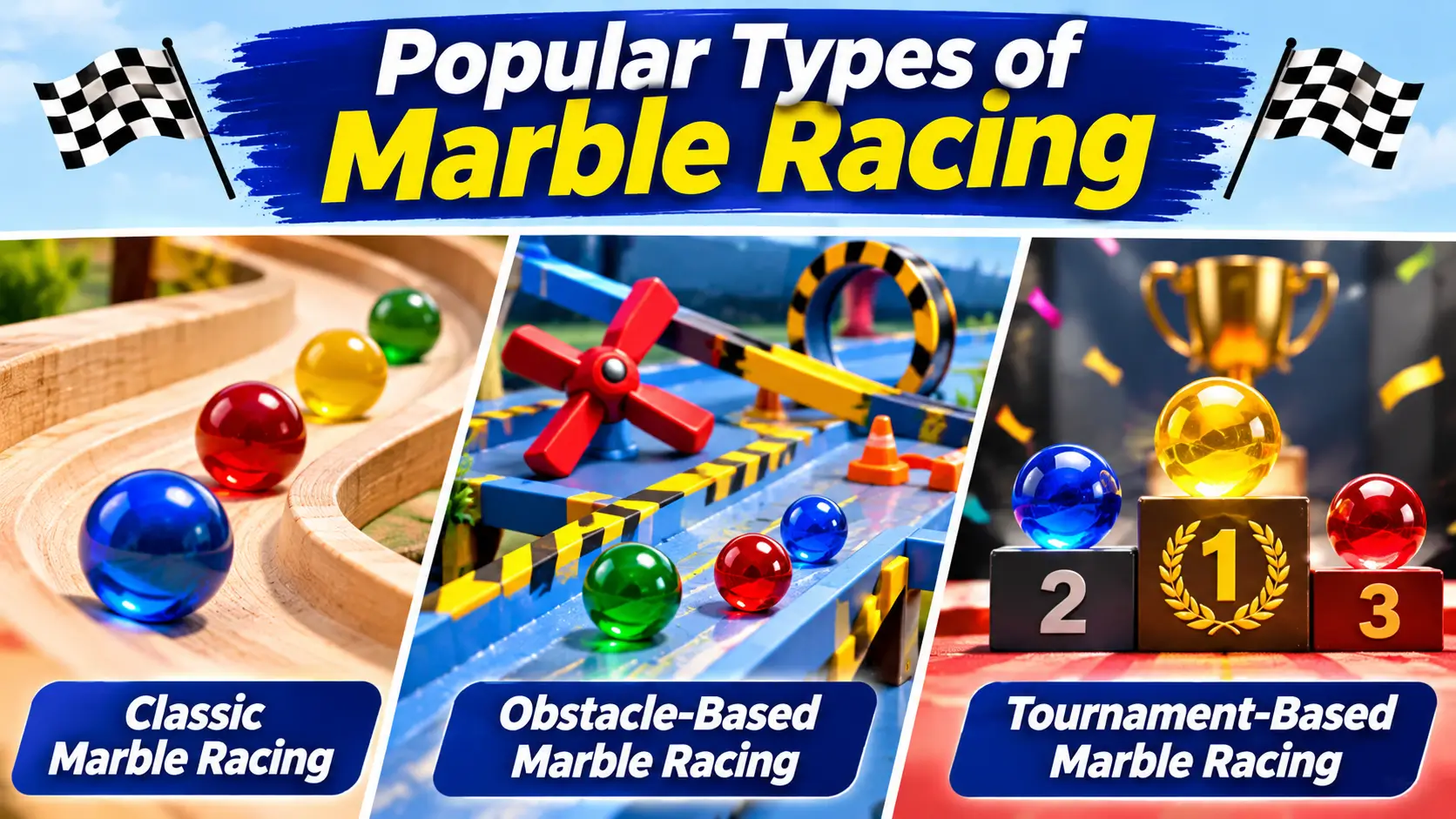
The Marble Race Game appears in several formats. Knowing the differences helps you understand what to expect before joining or watching a race.
Classic Track Racing
Classic racing uses a physical or simulated course with straight sections, slopes and bends. The marbles roll towards the finish, and the competition is decided by their finishing order. It is one of the easiest formats to follow because the objective is straightforward.
Obstacle-Based Racing
Obstacle tracks add features such as funnels, pins, rotating arms, tunnels, bumpers and narrow passages. These elements can slow a marble, change its direction or create close finishes. The design is often the main source of variety between courses.
Arcade Racing
Arcade versions may allow players to steer a marble, brake, accelerate or activate abilities. Some include levels, unlockable tracks, upgrades or time records. Because controls differ between games, the tutorial or control menu should be checked first.
Tournament and Elimination Racing
A tournament can include several races, with points awarded for finishing positions. In an elimination format, the lowest-ranked marbles may be removed after each round until one remains. The number eliminated and the scoring method are set by the organiser.
Online and Live Audience Races
Some browser-based experiences let users watch simulated races or enter participant names. Live-stream versions may allow viewers to join through comments or other platform interactions. Features such as player limits, boosts and leaderboards are specific to the service and should not be assumed to exist everywhere.
Track Features That Can Change a Race
Track layout is a major part of marble racing. Even when the same marbles take part, a different course can create a very different competition.
| Track Feature | Possible Effect | What to Notice |
|---|---|---|
| Steep slope | Can increase rolling speed. | How quickly marbles approach the next turn. |
| Sharp curve | Can change direction or reduce momentum. | Whether the track has a wide or narrow turn. |
| Funnel | Guides marbles towards a smaller exit. | How marbles enter and leave the funnel. |
| Bumper or pin field | Can create deflections and collisions. | How crowded the section becomes. |
| Tunnel | Can hide part of the race from view. | Where marbles reappear on the course. |
| Moving obstacle | Can alter the path or timing. | Whether the obstacle moves continuously or in cycles. |
These are general observations, not guarantees about a particular result. Track physics, marble weight, surface material and game settings can all affect movement. Digital simulations may also use their own programmed mechanics.
Marble Race Track: Start-to-Finish Flow
Illustrative track sequence only. Actual layouts and obstacles vary by race.
Beginner Tips for Following a Marble Race
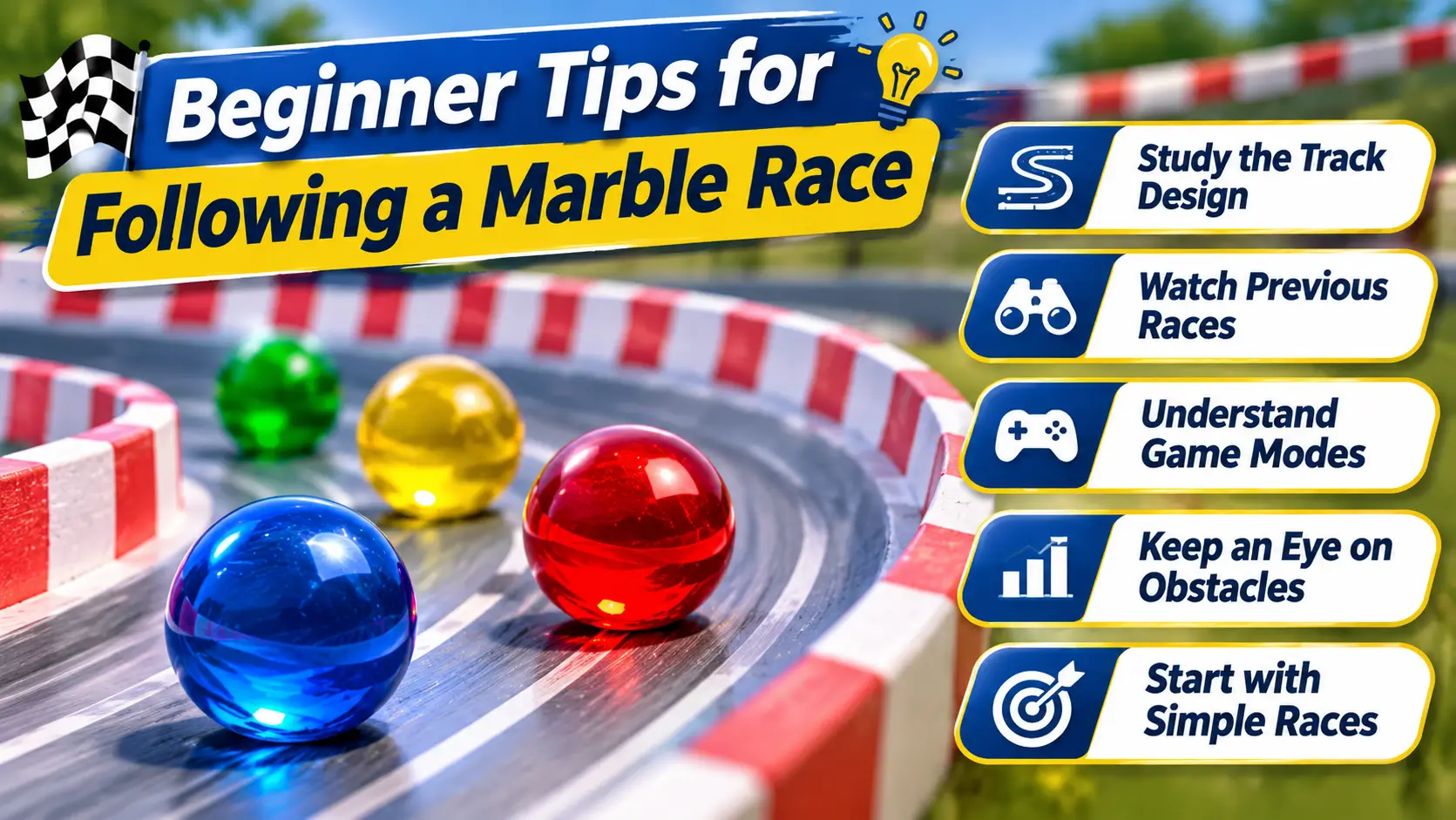
There is no reliable trick that can guarantee a winning marble in an unpredictable race. However, the following habits can help beginners understand the course and the rules more clearly.
Study the Course Before the Start
Look for the main turns, drops and obstacles. This gives you a better idea of where the race may become crowded or where the order could change. In a game with multiple tracks, learn the layout of each course separately.
Learn the Controls in Practice Mode
If the game includes steering, acceleration or special abilities, practise before entering a competitive round. Find out whether controls are continuous or activated with a single press. Avoid assuming that controls from one title will work in another.
Understand How Rankings Are Calculated
Check whether the game ranks marbles by finish order, elapsed time, points or elimination results. This is especially important in tournaments, where winning one race may not be enough to win the overall event.
Use Previous Results as Information, Not Certainty
Race history can help you understand earlier outcomes or compare track times. It cannot prove that the same marble will win again. Starting positions, obstacles, physics and randomised conditions may change from one round to another.
Start With Short and Simple Races
Beginners can learn faster by starting with a short course and a small number of competitors. Once the basic rules are clear, try more complex tracks or multi-round formats.
Marble Racing Formats at a Glance
Real marbles move along a built course. The experience focuses on track layout, gravity and collisions.
Software simulates the race. Users may watch the result or choose from options offered by the game.
Players may steer, accelerate or use abilities. Controls and objectives depend on the title.
This is a qualitative comparison, not a performance or popularity ranking.
Is Marble Racing Based on Skill or Luck?
The answer depends on the version. In a physical track race, factors such as the release, surface, marble size, track shape and collisions can influence the outcome. If participants can control the marbles, their decisions may also matter.
In an automatic digital simulation, the result may be driven mostly by the game’s physics engine, programmed settings or randomised conditions. In an arcade game with steering and abilities, player timing and control can have a greater role.
It is therefore inaccurate to describe every format as purely skill-based or purely luck-based. Read the rules of the particular version and understand what choices, if any, can influence the race. For more background, see this Marble racing overview.
Common Mistakes Beginners Should Avoid
- Skipping the instructions: Different versions can use different controls, scoring systems and race formats.
- Confusing watching with playing: Some experiences are simulations to watch, while others require active steering or decisions.
- Assuming the same rules apply everywhere: A physical track, arcade title and live event may work very differently.
- Overlooking the track layout: Obstacles and narrow sections can affect how a race unfolds.
- Treating old results as a guarantee: Previous finishing positions do not ensure future results.
- Ignoring platform terms: Review age requirements, privacy terms and safety information before using an online service.
Frequently Asked Questions
1. What is a Marble Race Game?
It is a racing activity in which several marbles travel along a track and compete to reach the finish. It can be played with a physical track or experienced through a digital simulation.
2. How do you play a marble race?
Choose a race format, review the course and controls, then start the marbles from the designated point. Follow the race and check the finishing order or scoring method shown by the game.
3. What are the basic rules of marble racing?
Most basic races require marbles to start from a defined area, follow the course and reach the finish line. Rules for leaving the track, ties and multiple rounds depend on the specific version.
4. Can beginners enjoy marble racing?
Yes. The basic objective is simple, and many versions are easy to follow. Beginners should start with a short race and learn any special controls before trying advanced modes.
5. Does every online marble race have the same features?
No. Some are automatic simulations, while others include steering, custom tracks, multiplayer options or tournaments. Check the individual game’s instructions to see which features are available.
6. Can previous race results predict the next winner?
Previous results can show what happened in earlier races, but they cannot guarantee a future result. Track conditions, starting positions and game mechanics may change.
Conclusion
The Marble Race Game is an accessible form of entertainment built around a simple idea: marbles compete along a course and are ranked by their performance. Physical tracks, arcade titles, online simulations and live audience events can all use the same basic racing concept while offering different rules and features.
The Marble Race Game is easiest to understand when you first identify its format, learn the track layout and check how the winner is decided. Start with simple races, use practice options where available and treat previous results as historical information rather than a promise about what happens next. Most importantly, enjoy the competition responsibly.